
Kimi Donahue: More Than One Thing

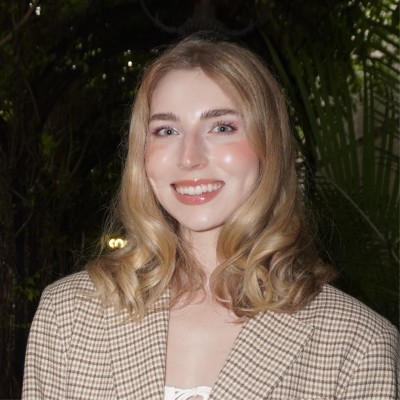
Beyond the label
For Kimiko “Kimi” Donahue, being nominated is proof of the thing she cares about most. “It means I'm making an impact,” she says. “That's what fills my cup, knowing that I left a mark, hopefully a good one, on people.”
Kimi owns Allegro Insurance Group in Tucson, Arizona, and is also a coach, keynote speaker, Certified Insurance Counselor, and the lead singer of a heavy metal band. Ask her what she's here to do, and she doesn't hesitate. “I feel like I'm here on this earth to help people that have felt misunderstood or underestimated,” she says.
She knows that feeling firsthand. Kimi grew up with Tourette Syndrome, and she learned early what it's like to be labeled.
“Just because you have that label or that title doesn't mean you're always that,” she says. “We can be more than one thing.”
That idea runs through everything she does, from her agency to her coaching to a keynote she gives on how women hold on to labels. Her favorite question to ask an audience: “Who are you when nobody needs you?”
Building her own evidence
People underestimated Kimi early, and for a while, she believed them. Being misunderstood meant constantly trying to prove herself. “That gets tiring,” she says.
What changed was building her own evidence. As she achieved more, she cared less about what others thought, and that made her stronger. “Now you're making decisions based on what you want, not based on what you think people are perceiving of you,” she says. “The biggest turning point was when I finally was able to let that go and say, ‘You know what? I'm gonna do it for me.’”

Finding her voice
Today Kimi is a keynote speaker, but she knows stage fright well. As a little girl, she froze with a deer-in-the-headlights look and ran off when it was her turn to present.
Her mother saw it happen and took action, signing her up for everything that would put her in front of people: theater, choir, and improv classes. “Mom's a smart lady,” Kimi says.
Speaking was still different from performing, because it meant being vulnerable instead of playing a part. For a while she believed she wasn't a good speaker. Practice changed that, along with a lesson from improv. “It's okay to look stupid,” she says. “You get up on stage, you make yourself look like an ass by saying dumb stuff, and if you can get over that, you can get up and talk about whatever you get excited about.”
Starting over, with purpose
Kimi has worked on both the captive and independent sides of insurance. She exited the business in 2022, but she couldn't stay away. She missed the field, people kept calling to ask for her help, and when a friend decided he no longer wanted to own his agency, she saw her chance.
She started from scratch, recruiting a team and building again. This time, she got to be picky. “You know what worked before. Now you know what you want, and we're building it a lot more intentionally,” she says.
Building with purpose has shaped how she leads.“She encourages her team to take calculated risks and adapt fast rather than sticking to ‘the way things have always been done,’” wrote Jopherson Mendoza, an executive assistant at Allegro who nominated her. At Allegro, mistakes are part of the culture, not something to fear. “There's nothing we can't fix in the world of insurance,” Kimi says.
Her team sees it too. “Kimi is the hardest working person I know,” wrote Sage Fuller, Allegro's Head of Operational Excellence, who also nominated her. “She encourages and supports her team in any way she can, and empowers us to excel in every aspect.”

No such thing as balance
Kimi built her career while raising her daughter as a single mom, and the hardest part, she says, was mom guilt. It peaked the day her daughter told her she didn't spend enough time with her.
“I'm like, ‘Ah, bad mom,’” she says. Then someone reframed it for her: of course her daughter wanted to spend time with her, because she was a good mom. “That changed everything,” she says. “Changed my relationship with her, changed how I show up as a mom, and also how I help coach other parents in the sales space.”
Her advice to them is honest. “There's no such thing as balance,” she says. Instead, be intentional and fully present wherever you are, and bring the people around you into your goals. “Tell them, ‘Here's my goals. It's gonna take some sacrifices. I need your help.’ And then they get to be a part of the goal with you.”
The teacher in her
Before insurance, Kimi wanted to be a teacher. Coaching lets her do both. “Whenever someone asks me what I would do for free if money wasn't a factor, I'd probably teach,” she says.
Her favorite thing to teach is getting past the fear of rejection, because she had it too. Her go-to question for nervous producers: what's the worst that can happen? “Someone curses you out and hangs up on you? How many times has that actually happened? And did you survive afterwards? Cool. You can do it again.”
With practice, she says, salespeople stop fearing rejection and start welcoming them, coming in with curiosity to find out what's really in the way. That skill matters more now than ever. “Sales is so important. It's more challenging, especially with technology and AI,” she says. “Having good communication skills becomes that much more important.”
Her reach goes well beyond her own office. “She goes above and beyond to coach those in her circle and across the US,” wrote Andee Reid, a colleague who nominated her.
Iron Priestess
Just like insurance, Kimi says she fell into heavy metal. A Tucson musician saw videos she'd posted on Facebook, singing acoustic in the office with one of her team members, and asked her to fill in as a singer for his AC/DC tribute band. “I'm like, you know what? I'll try this. That sounds super fun,” she says.
It took off from there. A lifelong metal fan, she went on to start her own band, Iron Priestess, a tribute to Iron Maiden and Judas Priest that most recently, started Miss Blizzard: A tribute to Ozzy Osbourne.
The stage carries the same lesson she teaches in sales. “We get so in our own heads. That's where the fear's coming from,” she says. “If you make it about the customer or you make it about the audience, you're putting that energy onto that instead of, oh my gosh, what if I mess up?”

Her message to women in insurance
Kimi's message starts with a caution: be careful with the label “woman.” “We're female and we can do some amazing stuff,” she says. “But don't let that confine you, because we're all still human beings.”
It's the same thing she wrote in her submission.
“I want other people to see that they don't have to fit a particular mold to lead in this industry,” she wrote. “You can bring your personality, your story, and your ambition with you.”
And while she no longer feels the need to prove herself, she admits it can still be fun. “Insurance opened doors for me,” she wrote. “Through my agency, coaching, and speaking, I'm working to help more people walk through theirs.”