
Nobody Does It Alone: 10 Lessons From Season 4 of Connected Conversations
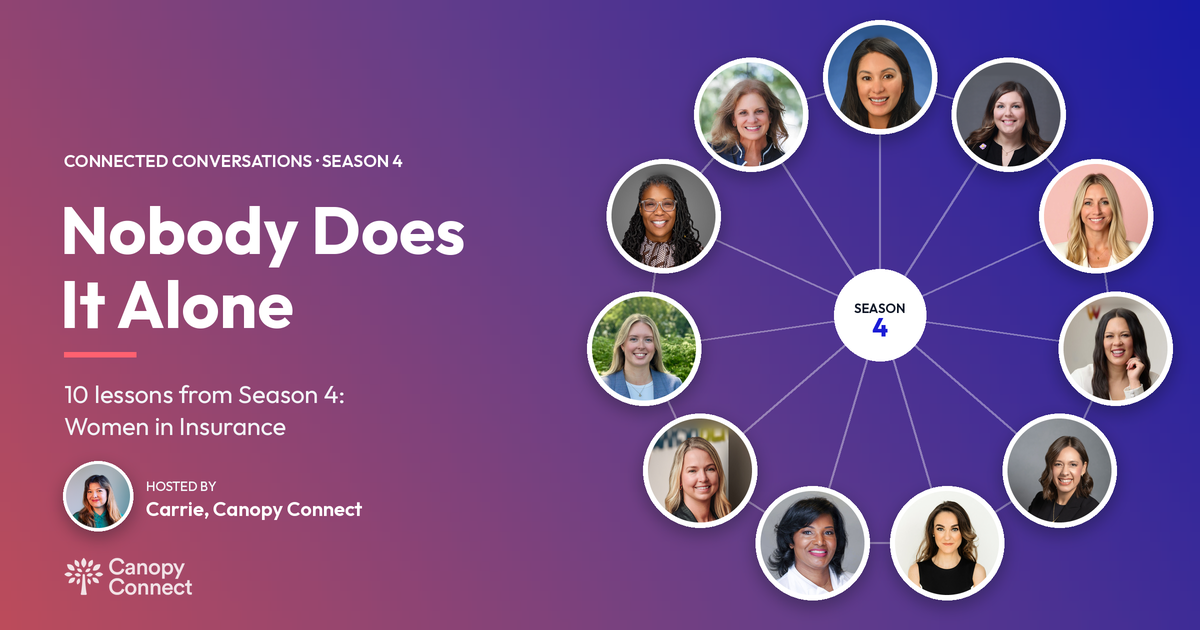

Ten episodes. Eleven women. One industry that is almost 60% female but still has fewer than 20% of women in senior executive roles.
Season 4 of Connected Conversations with Women in Insurance set out to tell one story across three acts. First the inner work: confidence, voice, ownership and burnout. Then the world around you: community, ambition and adaptability. Finally, the doors that need opening: opportunity, equity and vision.
The guests ranged from a first-year agency owner to the chair of the Big I. Their paths were different. Yet one message came up in every conversation, without anyone asking for it. In the finale, host Carrie named it: every guest, "unprompted," talked about helping and supporting each other. Angela called that connection a lifeline. Brooke Liu put it most simply: "Nobody does it alone."
Here are ten lessons, one from each episode in the order of the season's three acts, with steps you can start using this week.
Act 1: The Inner Work
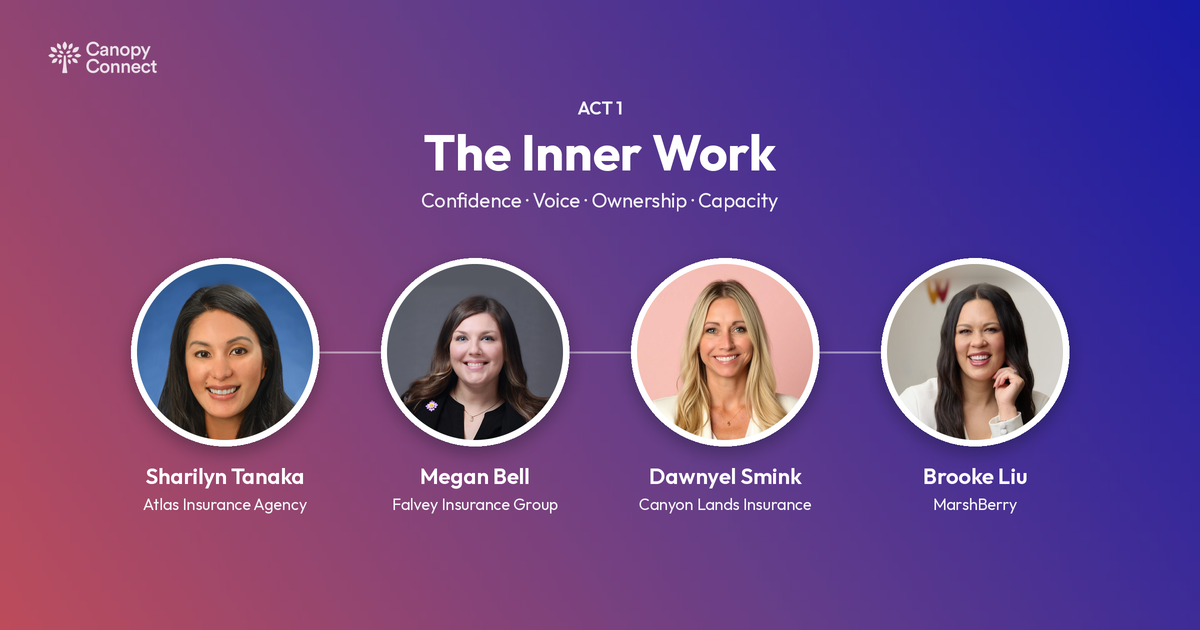
1. Treat confidence like a skill you practice — Sharilyn Tanaka (Ep 1)
Sharilyn, an EVP at Atlas Insurance Agency, is an introvert who still feels uneasy walking into rooms full of men. She built confidence on purpose, using five habits: evidence, action, visibility, support and consistency.
Try this:
- Keep a wins log. Add every accomplishment, however small, and use it at review time. "Nobody knows except for me."
- Apply at "most," not "all." If a role asks for three years and you have two, apply. Requirements "are just guides."
- Become the expert in one thing. Early on, Sharilyn read policies until nobody knew them better. Designations like CPCU, CISR, INS or CIC build knowledge "nobody can take away from you."
- Build your village: a mentor, someone you mentor, and a sponsor — a respected person who speaks for you "when you're not in the room."
- Reframe the room of strangers. "At one point this person didn't know anyone." You're just there to meet people.
- Say thank you when someone compliments your work, instead of deflecting.
2. Advocate for yourself without a fight — Megan Bell (Ep 2)
Megan, SVP of Marketing at Falvey Insurance Group and host of InsHER, is an introvert who spent years not using her voice. What changed it: learning that conflict can be "calm" and "fact-based" — a resolution, not a battle.
Try this:
- Open the hard conversation in writing. Send a short note: "I would really like to sit down to talk about X, Y, Z." Then the meeting isn't all nerves.
- Describe impact, not blame: "By doing this, it caused X, Y and Z."
- Bring your facts, and be ready for a no. Megan used to go in unprepared, hear no, and leave.
- Build presence after the meeting. If speaking up in the room is hard, follow up by email: "You said this. Here are my thoughts."
- Stop defaulting to note-taker, "Especially now that we have AI."
- Leaders: Close meetings with open office hours, credit ideas by name in recaps, and say "That's a really good point" when someone makes one.
3. Own your part, and prepare for the hard rooms — Dawnyel Smink (Ep 3)
Dawnyel runs Canyon Lands Insurance and the CLI Select network of 80+ locations. Her philosophy is personal ownership, and she backs it with simple tools. She also spoke openly about perimenopause, with a message for women managing it quietly: "You're not crazy and you're not alone."
Try this:
- Adopt a team phrase: "We need to clear the table." It gives anyone permission to name what's getting in the way — including something about you. Go first by admitting your own mistakes.
- Check the timing. If either of you is tired, hungry or not ready, table the conversation and come back.
- Pre-game the room. Play a song that pumps you up, wear your power colors, and plan which topics to raise and which triggers to watch for.
- Take a breath before you react. It resets your face and body language, not just your words.
- Don't stop at one doctor. Dawnyel's primary care doctor said nothing was wrong; a hormone specialist made the difference. "Do it sooner than later."
- Find a personal mentor about 10 years ahead of you who has already walked the path.
- In any room, look for the woman who seems unsure she belongs, and go talk to her.
4. Catch burnout early and ask for help — Brooke Liu (Ep 4)
After weeks on the road, the MarshBerry SVP tried to pay for a client dinner with her driver's license. She calls it "Low Power Mode": like a phone saving battery, your body quietly shuts down the extras first. "Burnout isn't a motivation problem," she said. "It's a capacity issue."
Try this:
- Watch the early signs. Sleep, workouts and time with friends slip before the big mistakes. Brooke watches her sleep scores.
- Say no, or offer a trade. Ask for a later deadline on one project to take on another, or suggest a colleague better suited to the task and review their work.
- Name an accountability partner before a heavy season — a friend or peer, not your boss or a direct report. Put a coffee on the calendar for when it's over.
- Run an Energy Clock audit (Molly Fletcher). Color-code your calendar by type of work. Brooke found about 60% of her time going to internal meetings, and handed some off.
- Use a mantra for crunch time: "This is temporary."
- Leaders: delegate the stretch work instead of hoarding it. Track revenue per employee and engagement scores, and standardize any task being done "17 different ways."
Act 2: The World Around You
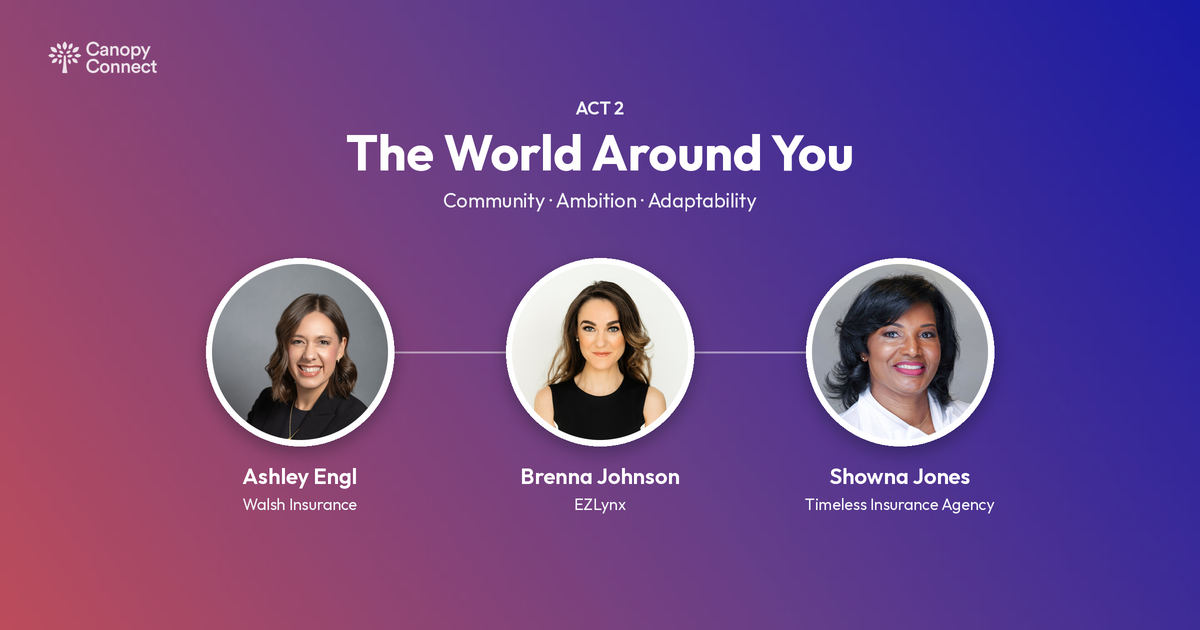
5. Build community in small bites — Ashley Engl (Ep 5)
Every step of Ashley's career came through someone who saw potential in her. Now Director of Technology, Learning & Innovation at Walsh Insurance, she shows how to build a network without a big budget or a big personality.
Try this:
- Send one LinkedIn message to someone you admire — even a competitor — and suggest a 15-minute virtual coffee.
- Find your state's women's summit. Big I state associations are launching them, and they draw CSRs and admin staff as well as leaders.
- Join a working group you can attend from your desk: the Big I ACT Committee, Big I National Young Agents, or your agency management system's user community. Follow up on LinkedIn with people from the chat.
- Set connection goals before an event. Decide who you want to meet and message them ahead: "I look forward to stopping by your booth."
- Be the welcomer. Spot the new face and say: "This is who I am. Welcome. We want you to be here."
- Leaders, invite in person. Swap the FYI forward for: "I'm attending, and I'd love for you to come along with me." Add why it helped you.
6. Take your seat, then set your pace — Brenna Johnson (Ep 6)
Early in her career, the EZLynx SVP was invited into an executive meeting and sat against the wall. A mentor told her she had taken herself out of the room. Years later, after her daughter was born, she learned that slowing down for a season doesn't make you less ambitious.
Try this:
- Sit at the table. If you were invited into the room, take a seat with everyone else — literally.
- Ask two or three people close to you to name your strengths and weaknesses. Build your leadership style from that, not by copying anyone, Brenna included.
- Apply for the stretch role. "You get turned down for 100% of the things that you don't ask."
- If you need to slow down, say it plainly and frame it as a season: Yes, you want that opportunity, just not right now.
- Curious about insurtech? Look at subject-matter-expert and solutions-consultant roles, and ask vendor reps at conferences what's open.
7. Stretch before you're forced to — Showna Jones (Ep 7)
When no one would hire this Army veteran and 20-year claims leader, an agency owner suggested she start her own. Within a year of launching Timeless Insurance Agency, she owned a full agency. "Adaptability is really choosing growth before you're forced to do it," she said.
Try this:
- Volunteer for one thing outside your job. Showna joined a branch committee the day a manager called her complacent, and "the role sought me out" after that.
- Ask a leader directly: "Is there a project I can assist or even lead?"
- Shadow someone in a role you're curious about — an adjuster learning litigation, for example. It can be informal.
- Pick your head up on a regular schedule and ask what's next for your own brand, not just your employer's.
- Planning your own agency? Look for a structured mentoring program and an aggregator's agency development program. Lean on long-time mentors and agency owners you meet through groups like CPCU and NAAIA.
- Count leaving as a valid choice. Walking away from a role that's a daily fight can be a success, not a failure.
Act 3: The Doors That Need Opening
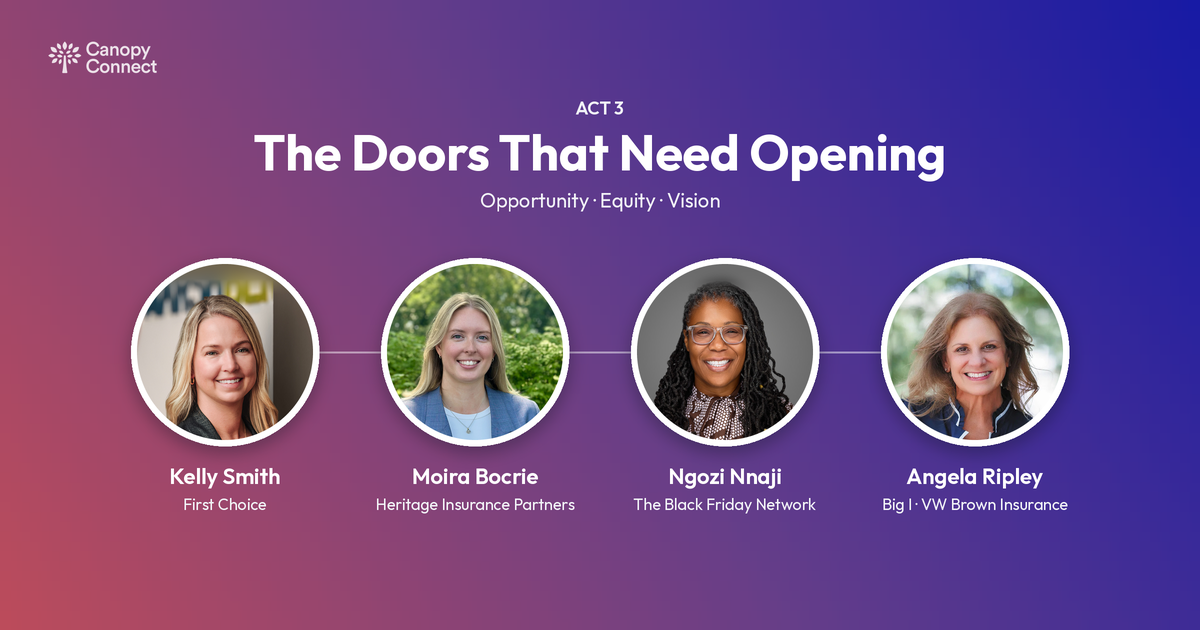
8. Tell a better story about insurance — Kelly Smith & Moira Bocrie (Ep 8)
Kelly, a Regional VP at First Choice, asked her teens what they think of when they hear "insurance." Her daughter said "taxes." Her son, who'd been to industry events with her, said "my future." She and Moira, a third-generation agent, think the industry's biggest barrier is the story it tells.
Try this:
- Spend an extra 30 seconds when someone asks what you do. Explain the work and why you love it, not just "insurance."
- Change the words with young people. Kelly says "risk management" instead of "insurance." Bring kids or students to the fun side of the industry, like a networking event.
- Build a niche around what you love. One agency insures gun collections; it could be horses, roller coasters or med spas. "Every single thing out there needs insurance."
- Apply anyway. If you meet 5 of 10 requirements, apply. Moira's motto is "fake it until you become it."
- Show up curious. Bring prepared questions, and remember "it's okay to show up to a conversation and say, 'I don't know something.'"
- Advocate for licensing in high schools, next to the trades. Working part-time in an agency first makes the exam easier to pass.
9. Build a future that includes everyone — Ngozi Nnaji (Ep 9)
Ngozi founded the Black Friday Network after hitting barriers to appointments, capital and clients despite 20 years of experience. Her point: "the future is female" must include every woman, and the industry's own measures can hide who is being left out.
Try this:
- Allies: ask, then listen. Don't decide what someone needs. "Your assumptions might not be my reality."
- Check your benchmarks. Before judging an agency against top-25% numbers, ask whether it has the same access to capital to hire producers and invest.
- Talk about insurance as wealth-building, not just claims — a way to protect assets and create generational wealth.
- Use technology to buy back time. Automating hand-offs between tools frees owners to produce.
- Look beyond distribution. Ownership paths include TPAs and consulting firms, not only agencies.
- Black women in insurance: connect with Ngozi on LinkedIn to find the Black Friday Network and the Sisterhood Conference. "There is a community that exists for her."
10. Get involved before you feel ready — Angela Ripley (Ep 10)
Angela is only the second woman in the Big I's 129-year history to chair the association. She never planned it. Other women told her she could do it, and she ran "to show other women that it can be done."
Try this:
- Join your state Big I association and say yes to one role. "Your day will expand to meet the need of getting involved."
- Find a women-in-insurance event near you on the Big I's national listing — and invite a male colleague along.
- Encourage one woman by name. Angela's push came from someone who said, "If I'm doing it, you can."
- If you're mid-career and stuck, block intentional time to think, and consider a different part of the industry rather than leaving it.
- Work with a coach for big transitions. Angela is using one to plan her next chapter.
- Tenured leaders: "push down the knowledge." Introduce people and invite them into the room.
Start here
Ten episodes, dozens of tips. If you only do three things this week:
- Write down three wins from the last month. (Sharilyn)
- Send one message to someone you admire and ask for a 15-minute coffee. (Ashley)
- Personally invite one person to the next event you attend. (Ashley, Angela)
None of it happens alone. Find your village, invite someone in, and keep going.
Thank you for listening to Season 4 of Connected Conversations from Canopy Connect. We'll see you for Season 5.